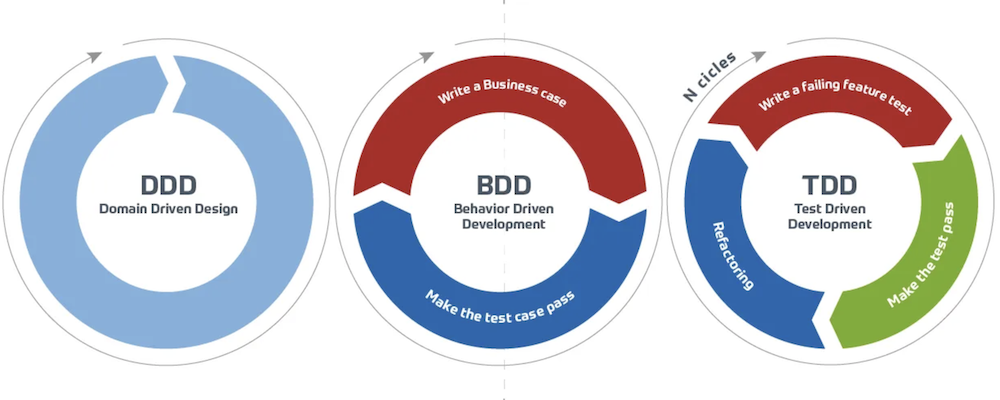
Software development has matured significantly over the past few decades. Building and deploying software is no longer a task for a single developer, but rather a collaborative effort involving entire teams. Over time, various software development methodologies have emerged, each providing proven best practices for delivering robust, maintainable, and valuable software solutions. This post explores some of the key methodologies often used in modern software development.
Software Development Methodologies
In this post, we will introduce three widely adopted methodologies: Domain-Driven Design (DDD), Behavior-Driven Development (BDD), and Test-Driven Development (TDD).
Domain-Driven Design (DDD)
Domain-Driven Design is an approach to software development that focuses on modeling software based on the core business domain. Introduced by Eric Evans, DDD emphasizes deep collaboration between technical experts and domain experts.
DDD starts by identifying the core domain and its subdomains. It involves building a shared understanding and ubiquitous language between stakeholders and developers. The process includes designing bounded contexts, defining aggregates, entities, and value objects to represent the domain accurately.
Pros:
- Promotes alignment between business and technology
- Improves maintainability and scalability
- Encourages clear boundaries between components
Cons:
- Requires significant upfront investment in understanding the domain
- May be complex and heavyweight for small or short-term projects
DDD is ideal for complex systems where business rules are at the core, such as banking, insurance, or large-scale enterprise applications.
For example:
In a banking system, managing customer accounts, transactions, and fraud detection involves complex business rules that differ across domains. Using DDD helps separate bounded contexts (Accounts, Transactions, Fraud), allowing each team to focus on business logic. This model is suitable because the domain complexity and multiple teams require clear boundaries and deep domain knowledge.
Behavior-Driven Development (BDD)
Behavior-Driven Development is an evolution of TDD that focuses on describing system behavior in plain language understood by both technical and non-technical team members. It bridges the gap between requirements and tests.
BDD typically involves writing specifications in a Given-When-Then format using tools like Cucumber. The process starts with collaborative discussions around expected behaviors, then formalizes them into executable specifications.
Pros:
- Improves collaboration between developers, testers, and business stakeholders
- Ensures requirements are clear and testable
Cons:
- Requires learning new tools and writing additional specifications
- May be overkill for very small projects
BDD is especially useful in projects where communication between technical and non-technical stakeholders is key, such as customer-facing applications.
For example:
For a ride-sharing app feature where users request rides and drivers accept them, BDD lets product managers, testers, and developers collaboratively define scenarios like “Given a rider requests a trip, when a driver accepts, then the trip status is confirmed.” This model is suitable because clear communication and shared understanding of requirements are crucial in a cross-functional team.
Test-Driven Development (TDD)
Test-Driven Development is a methodology where developers write tests before writing the actual implementation code. It emphasizes short, iterative cycles of writing failing tests, then producing the minimum code necessary to pass them.
TDD follows the Red-Green-Refactor cycle: write a failing test (red), write code to make it pass (green), then improve the code while keeping tests passing (refactor).
Pros:
- Leads to highly testable, modular code
- Reduces defects and improves confidence in changes
Cons:
- Can slow initial development
- May not be suitable for rapid prototyping or exploratory work
TDD works well for backend services, API development, and scenarios where reliability and correctness are critical.
For example:
Building a data processing library that parses sensor data streams, developers start by writing tests for parsing known formats correctly. This ensures correctness early and helps catch regressions. TDD is suitable here because reliability and correctness of the library are critical.
Comparison
| Model | Core Concept | Advantages | Disadvantages | Suitable For |
|---|---|---|---|---|
| DDD | Domain Modeling | Handles complexity well | Steep learning curve | Complex business systems |
| BDD | Behavior Scenarios | Good cross-team collaboration | Scenario maintenance cost | User-driven requirements |
| TDD | Test First | High quality, low defects | Time-consuming initially | Core business logic |
Some findings and thoughts
- Modern methodologies like DDD, BDD, and TDD each have their strengths, trade-offs, and contexts where they shine.
- Choosing the right methodology depends on the project complexity, team collaboration needs, and business requirements.